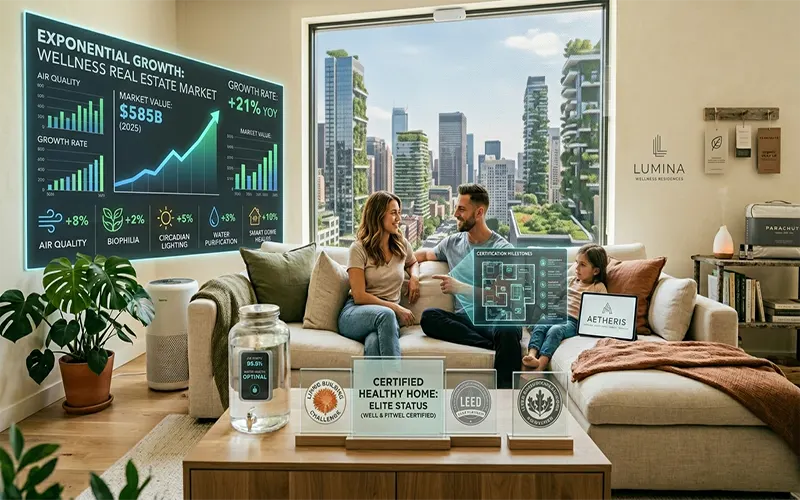
In 2026, the global real estate market has undergone a fundamental transformation. We have moved beyond the era of “luxury as an aesthetic” into the era of “luxury as a biological performance.” The global wellness real estate market is currently valued at approximately $721 billion, with a projected surge toward $1 trillion by the end of the decade.
This shift is driven by the “Wellbeing Address” concept: the emerging scientific and economic consensus that where you live is a more accurate predictor of your healthspan than your genetic code. For developers and investors, “Health” is no longer a soft amenity; it is a hard asset that drives higher rents, faster sales, and long-term portfolio resilience.
Market Growth Drivers: Why Wellness is Winning in 2026
The rapid acceleration of this sector is fueled by a convergence of institutional capital and a permanent shift in consumer psychology:
- The Post-Pandemic Legacy: While the acute phase of the 2020s health crisis is behind us, it left a permanent imprint on the consumer. Indoor Air Quality (IAQ) has moved from a technical niche to a primary buyer requirement. High-net-worth individuals (HNWIs) now view advanced filtration as essential as high-speed internet.
- Longevity Science as Real Estate: We are seeing a merger between longevity clinics and residential developments. Communities are now being designed as “points of care,” where the home environment proactively manages the resident’s health through integrated biohacking systems.
- Institutional De-Risking: Real Estate Investment Trusts (REITs) are increasingly prioritizing wellness-certified assets. In an era of global volatility, properties that demonstrably protect occupant health show higher price resilience and lower “negotiation drag” at resale. In 2026, certified healthy buildings are commanding a 7.7% rent premium over non-certified peers.
The 2026 Healthy Home Certification Landscape
Certifications have become the “shorthand” for quality, providing the verification required to turn a wellness claim into a measurable asset.
| Certification | Focus & Philosophy | 2026 Innovation / Status |
| WELL Building Standard (v2/v3) | Human-centric; focuses on 10 concepts (Air, Water, Light, Mind, etc.) | The gold standard for “Total-Home Ecosystems.” |
| Fitwel v3 | Behavioral health and social connectivity via evidence-based design. | Now the leader for “at-scale” portfolio certifications. |
| LEED v5 | Decarbonization + Human Health; the hybrid of planet and person. | New 2026 requirements for mandatory air quality monitoring. |
| Living Building Challenge | Regenerative and “Circular”; buildings as living organisms. | The benchmark for the industrial circular economy in real estate. |
- WELL v3: In 2026, WELL has expanded its reach into over 74,000 locations globally. Its v3 update places a heavy emphasis on “Human-AI Harmony” and the psychological impact of digital environments within the home.
- Fitwel v3: This year, Fitwel has celebrated record-breaking recertifications, emphasizing that healthy building performance must be maintained, not just achieved. It is particularly dominant in the “Middle Market” where it provides a cost-effective roadmap for healthier community living.
Technological Integration: Total-Home Wellness Ecosystems
The “Wellness Home” of 2026 is a quiet, invisible machine. The most compelling developments treat wellness as a coherent strategy rather than a menu of features.
- Circadian Lighting 2.0: No longer just “dimmable bulbs,” 2026 systems use architectural-level integration to align artificial light with the body’s natural day-night cycle. This technology is linked to a 20% improvement in cognitive performance and is a core specification in luxury biohacking homes.
- Acoustic Wellness: Sound isolation is the new privacy. “Sound comfort” is now quantified and measured during the sales process. High-rise developments are using advanced sound-absorption materials to ensure that a unit in the heart of a city provides the acoustic silence of a remote retreat.
- Air as an Amenity: Whole-home purification systems that control particulates and allergens are now integrated and near-silent. These systems are being framed as essential for immune response and long-term respiratory health.
Top 5 Wellness Amenities of 2026
- Recovery-as-a-Service: Residential spa rituals including precision-controlled cold plunges and contrast therapy.
- Mind-Body Studios: Dedicated spaces for breathwork and mobility that prioritize acoustic and light quality over size.
- Biophilic “Third Spaces”: Indoor-outdoor terraces designed to maximize natural light and proximity to greenery.
- Water Strategy: Whole-building filtration that ensures mineral-rich, contaminant-free water for both drinking and bathing.
- Acoustic “Quiet Zones”: Designated areas within the home engineered for zero-decibel deep work.
The ROI of Wellness
The data from early 2026 confirms that wellness real estate is the most resilient asset class in the current cycle. Investors are moving away from visual luxury toward biological luxury because health is the ultimate hedge against uncertainty.
As we look toward 2029, the integration of health certifications and autonomous wellness technologies will not be a differentiator—it will be a requirement for market entry. In the future of real estate, the most valuable square footage is the one that adds years to the lives of those who inhabit it. The “buy less, buy better” philosophy has finally arrived in the housing market, making healthy homes the cornerstone of a sustainable, circular economy.